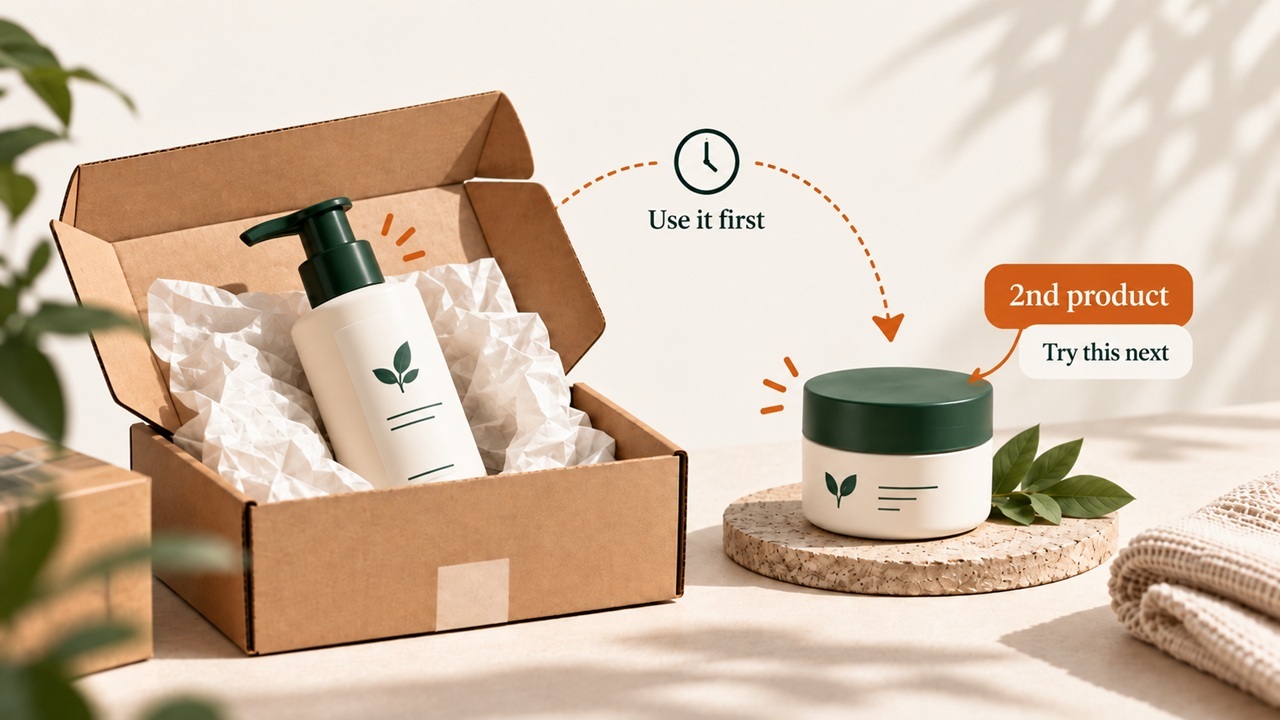
A customer can reorder the same product for months and never discover anything else you make.
That sounds like a loyal customer, and it is the quiet way brands lose them. There is a difference between someone who orders the same product five times and someone who has found five reasons to come back. The first knows the product. The second is starting to know the brand, and the brand has far more to hold onto.
For a direct-to-consumer (DTC) brand this is a choice you are making without noticing. You control the product page, the checkout, the replenishment reminder, the subscription shipment, and the packaging. Every one of those could introduce a useful second product. Most brands spend all of them promoting the product the customer already buys, and the repeat purchase rate looks healthy the whole time, which is exactly why the gap goes unseen.
AI insight extraction
Reading article context…
Key takeaways
- A single-SKU customer is a retention risk, not a retention win. If the one product they know stops fitting, they have no other reason to stay, and your repeat purchase rate hides this completely.
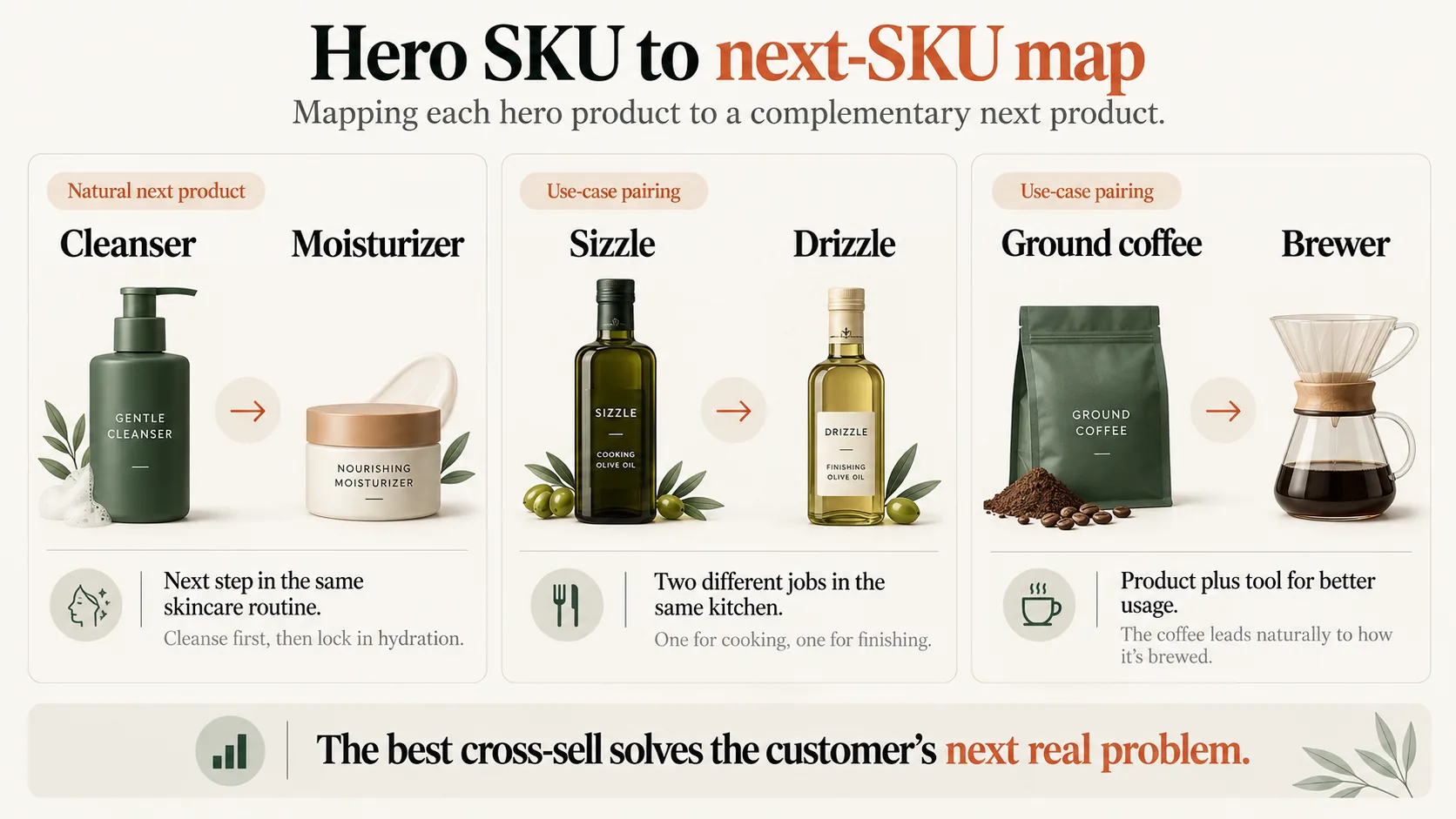
- The best cross-sell has a job. It solves the next problem the customer is likely to have, not “customers also bought.” A real product pairing follows a use case: cleanser then moisturizer, Sizzle then Drizzle.
- Timing is the hard part, not the offer. A post-purchase cross-sell sent the morning after the first order arrives before the customer has opened the box. The right moment is after they have used the first product long enough to want the next.
- Subscriptions and packaging are discovery surfaces. An upcoming shipment or an unboxing reaches a customer who is already engaged, so an add-on or a matched sample lands better than an unrelated email.
- Measure product breadth, not just repeat orders. Track whether customers adopt and then repurchase a second product. Repeat purchase rate alone cannot tell you that.
Why a single-product customer is a retention risk, not a retention win
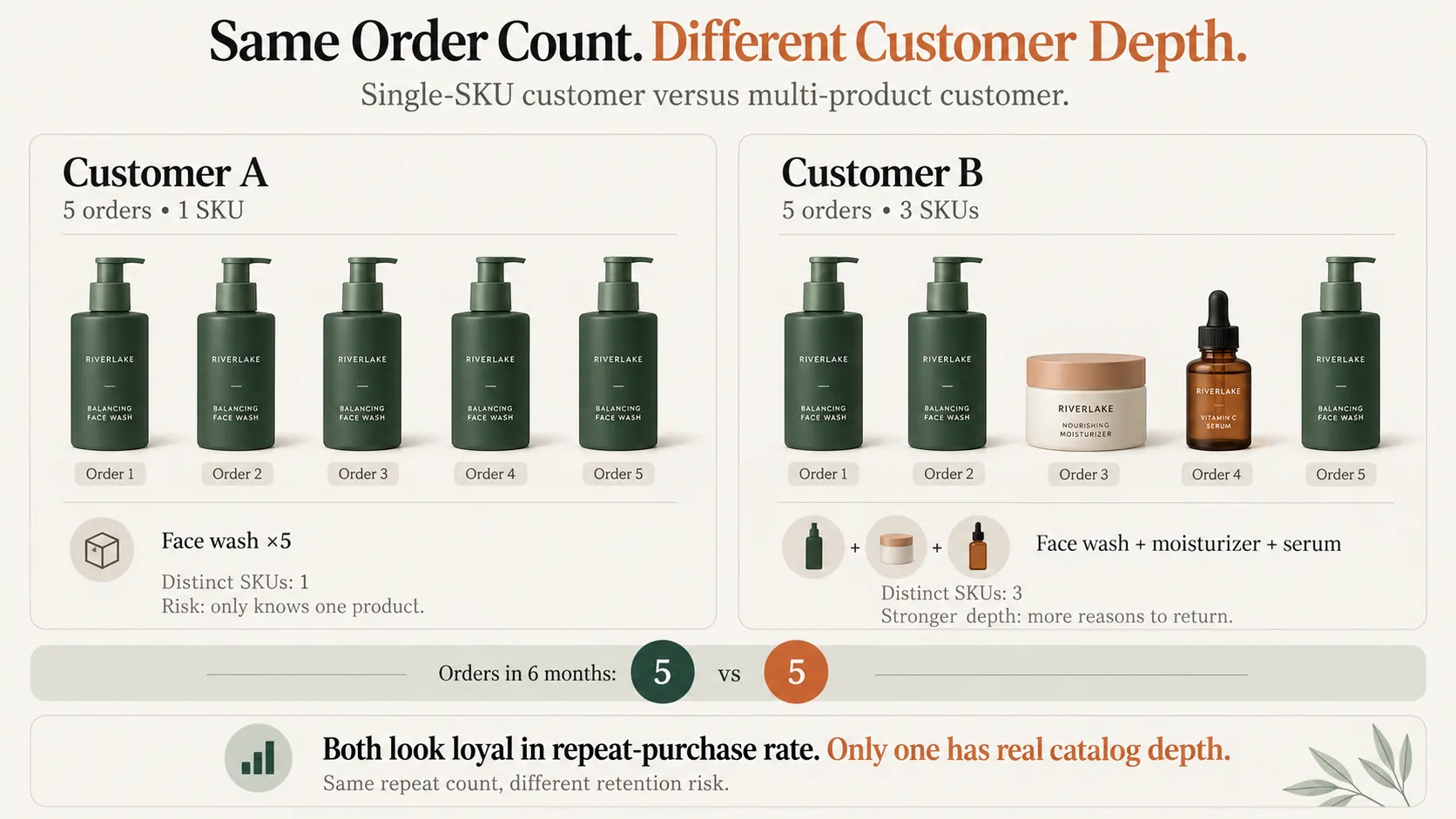
Two customers with identical order counts can carry completely different risk. Take two who each order a face wash five times. Customer A has never tried anything else. Customer B bought the face wash, then added a moisturizer, then a serum.
- Orders in 6 months: both placed 5.
- Distinct SKUs: Customer A bought 1. Customer B bought 3.
- If the face wash is reformulated or lapses: Customer A has no other product they trust. Customer B has two other reasons to return.
- What a topline repeat rate shows: both look loyal.
The repeat purchase rate reads both as wins. Only one of them is durable. This does not prove multi-product customers are automatically more loyal, since they may have had stronger purchase intent to begin with. It does name a risk the topline number hides.
So the first question is not “how do we get this buyer to spend more at checkout?” It is “which second product is genuinely useful once the first has done its job?” For a cleanser customer, a compatible moisturizer. For someone buying ground coffee, a brewing product or a roast that matches their taste. The pairing follows a real use case, not the highest-margin item in the catalog.
To find the risk in your own data, split repeat buyers into a single-SKU group and a multi-product group, then compare how long each stays active, how often they reorder, and their contribution margin.
Pro tip. Run the single-SKU vs multi-product split inside one acquisition cohort and one category at a time. A coffee customer and a skincare customer replenish on different clocks, and mixing them makes the multi-product group look healthier for reasons that have nothing to do with breadth.
Why DTC cross-selling often misses the moment
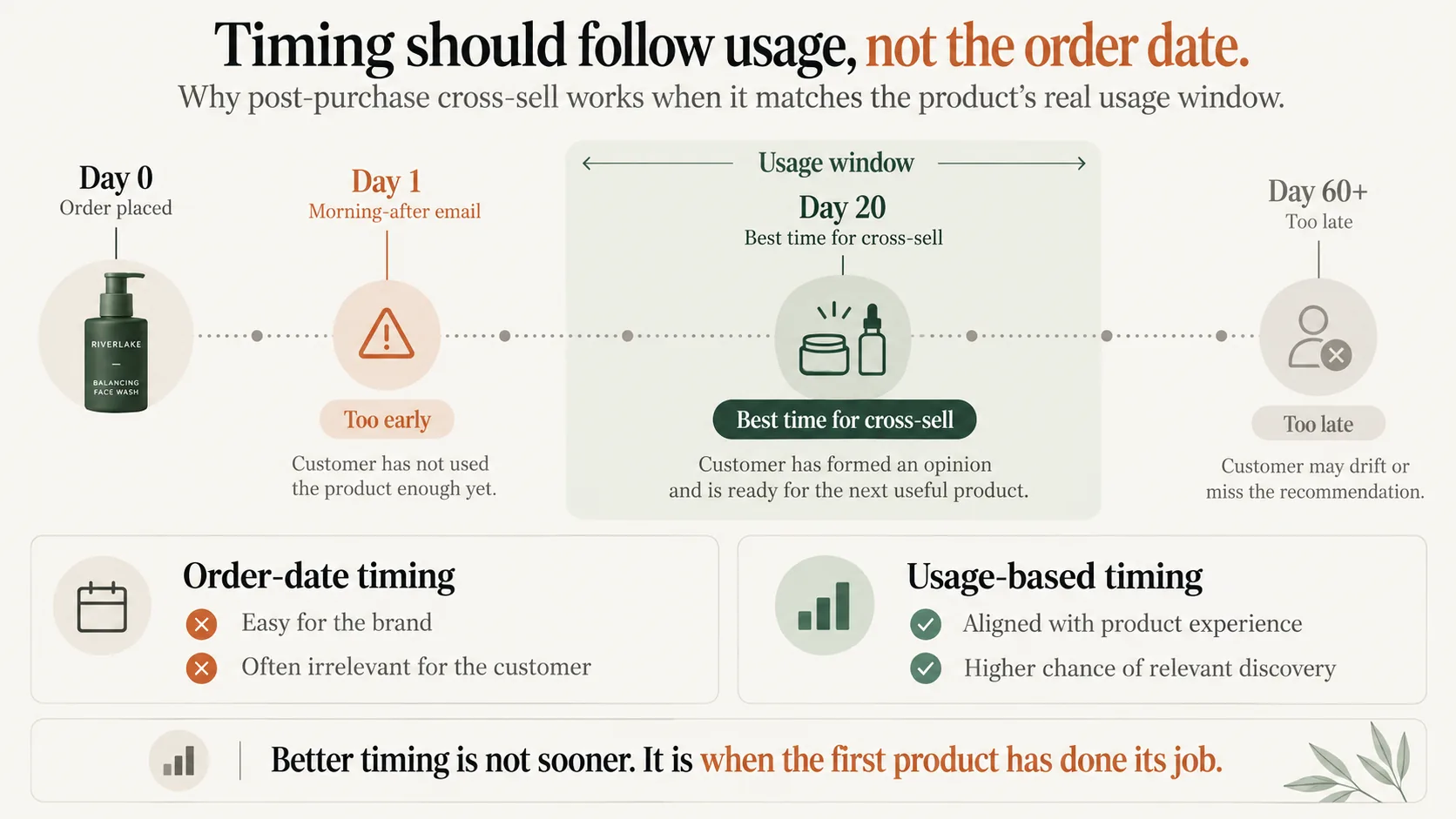
Most cross-sell fails on timing, not on the offer. A generic “customers also bought” carousel gives everyone roughly the same answer. A post-purchase email sent the next morning can land before the customer has opened the first order. These placements are convenient for the merchant and rarely match when someone actually understands why a second product would help.
Better post-purchase cross-sell starts from three pieces of context: what the customer bought, why they bought it, and roughly when they will have used it enough to consider something else. Purchase date is only a rough proxy for product use, so where you do not know actual usage, do not pretend the timing is exact.
Brand example, The Ordinary. Its online Regimen Builder asks about skin type and concerns, then helps shoppers assemble a routine. The principle worth copying is not “sell more skincare.” It is “show why another formulation belongs in the same routine.” A brand selling a daily cleanser can borrow that after the first order: “if the cleanser is working for you, here is the moisturizer built for the next step.” The message should explain compatibility, usage order, and who should skip it. In skincare, relevance and safe use beat the biggest possible bundle.
Checkout recommendations still have a role, especially for clearly complementary products. But if a shopper ignores an offer there, do not treat the product as unwanted forever. You may have asked before they had the context to answer.
Pro tip. Use each category’s median reorder interval as the usage-window proxy, then place the cross-sell at roughly 60 to 70% of it. For a 30-day consumable that is around day 20, late enough that the customer has formed an opinion, early enough to catch them before they drift.
The subscription box is a merchandising surface, not just a reorder vehicle
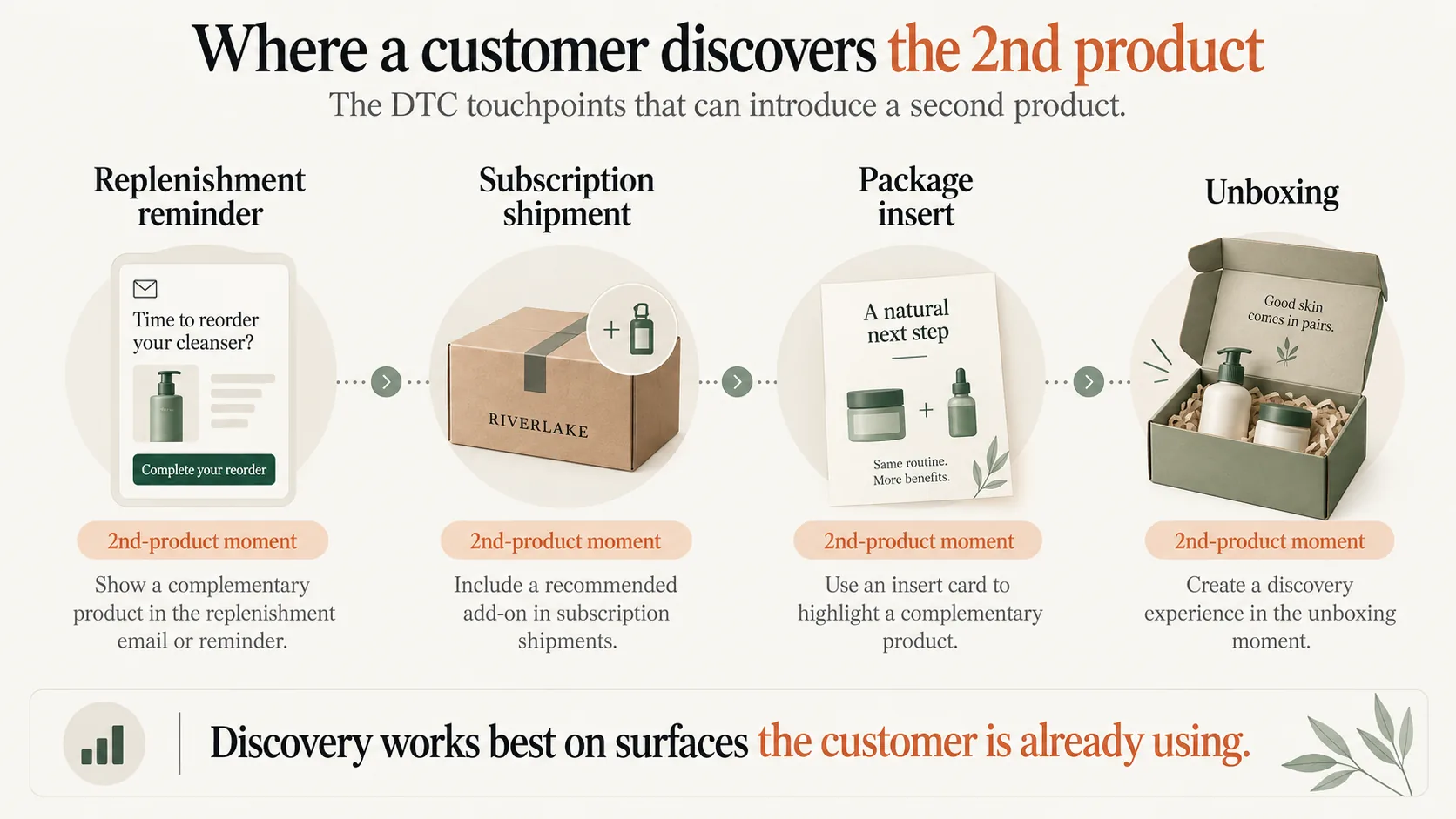
Once replenishment is reliable, every upcoming shipment is a second chance to introduce a product. You can offer an adjacent item while the customer is already expecting a delivery, with no need to make them start a new shopping trip. This is where subscription cross-sell and add-ons earn their place.
Brand example, BARK. BARK lets subscribers use “Add To Next Order” on eligible products, so extra toys or treats ship with the next box. Its assortment also rotates in different items instead of repeating the same toy every month. The lesson is to make discovery part of a shipment that is already coming.
Brand example, Graza. Graza sells Sizzle for cooking and Drizzle for finishing, and offers the pair as a subscription with refills. Two distinct jobs in the same kitchen. The bundle explains why a customer would want both, instead of leaning on a generic “you may also like.”
For a consumer packaged goods (CPG) subscription, that becomes an optional sample, a relevant one-time add-on, or a clearly explained swap. Give the price, the product details, and an easy way to decline before the order-edit cutoff. Never add a paid item automatically, and if something is out of stock, suppress the offer rather than sending the subscriber into a dead end.
The test is whether the extra product makes the next delivery more useful, not whether it bumps order value this month. Track add-on acceptance, whether the new item gets bought again, and the margin left after shipping and any sampling cost.
Pro tip. Fire the add-on offer against the order-edit cutoff, not the ship date. Give the subscriber at least 48 hours to say no, and default the add-on to off. An add-on the customer had to actively remove is a return and a cancelled subscription waiting to happen.
Packaging and unboxing can create a second-product discovery moment
When a customer opens something they chose to order, the brand is already in front of them. That makes a package insert or a product sample relevant in a way an unrelated promo email is not. It also sets a constraint: the recommendation has to make sense next to the item in the box.
Brand example, Dossier. Its Dossier+ membership includes a free 3 mL fragrance sample with every order, a concrete way to let an existing buyer try another scent. That is not, by itself, proof that samples lift retention. The brand would still need to measure whether sample recipients later buy the sampled fragrance.
Say a customer orders an electrolyte mix. A useful insert introduces a recovery snack with one line on when you would use it, plus a QR code or short link to that exact item. A vague “explore our full range” card pushes the discovery work back onto the customer. And “people who buy this also buy that” should only appear when your order data actually supports it, a real product affinity rather than a guess.
Operationally, start with a few high-volume hero products and one companion item for each, and match inserts to the purchased SKU or category rather than every package. If a sample carries allergens, usage restrictions, or any risk of incompatibility, make that clear.
Pro tip. Point the QR code at a pre-filled cart for the exact companion SKU, not the homepage or a collection page. Every step between the scan and the checkout is where the intent leaks, and you created that intent for free by putting the card in the box. Count sample-to-purchase conversion separately from QR scans, because a scan is interest and only a purchase is adoption.
Discovery needs a sequence, not a single offer
A buyer opening their first order and a customer placing their sixth do not have the same questions. The first wants to know the initial choice was right. The sixth may be ready to explore the range. Sending both the same cross-sell throws away context you already hold in their purchase history.
A workable sequence runs in three stages:
- First purchase and early use: send guidance that helps the customer get the intended value from what they bought. No cross-sell yet.
- After a reasonable usage window: introduce one adjacent item tied to the same routine.
- Established repeat buyers: test a sample or a small assortment from a nearby category, once you have earned some trust.
Across all three, remember what each person has tried, bought, declined, or already seen. Someone who passed on the same serum twice should not meet it in every email and box. Suppress products they already own unless the message is explicitly about replenishment, and treat stock, product restrictions, and the customer’s consent and channel preferences as basic eligibility rules.
This does not require a recommendation engine to begin. A simple map of hero SKU to compatible next SKU, plus purchase-history exclusions and sensible timing, is enough for a first test. Our guide to raising your repeat purchase rate covers the replenishment-timing half of this; this post covers the discovery half.
What to actually track
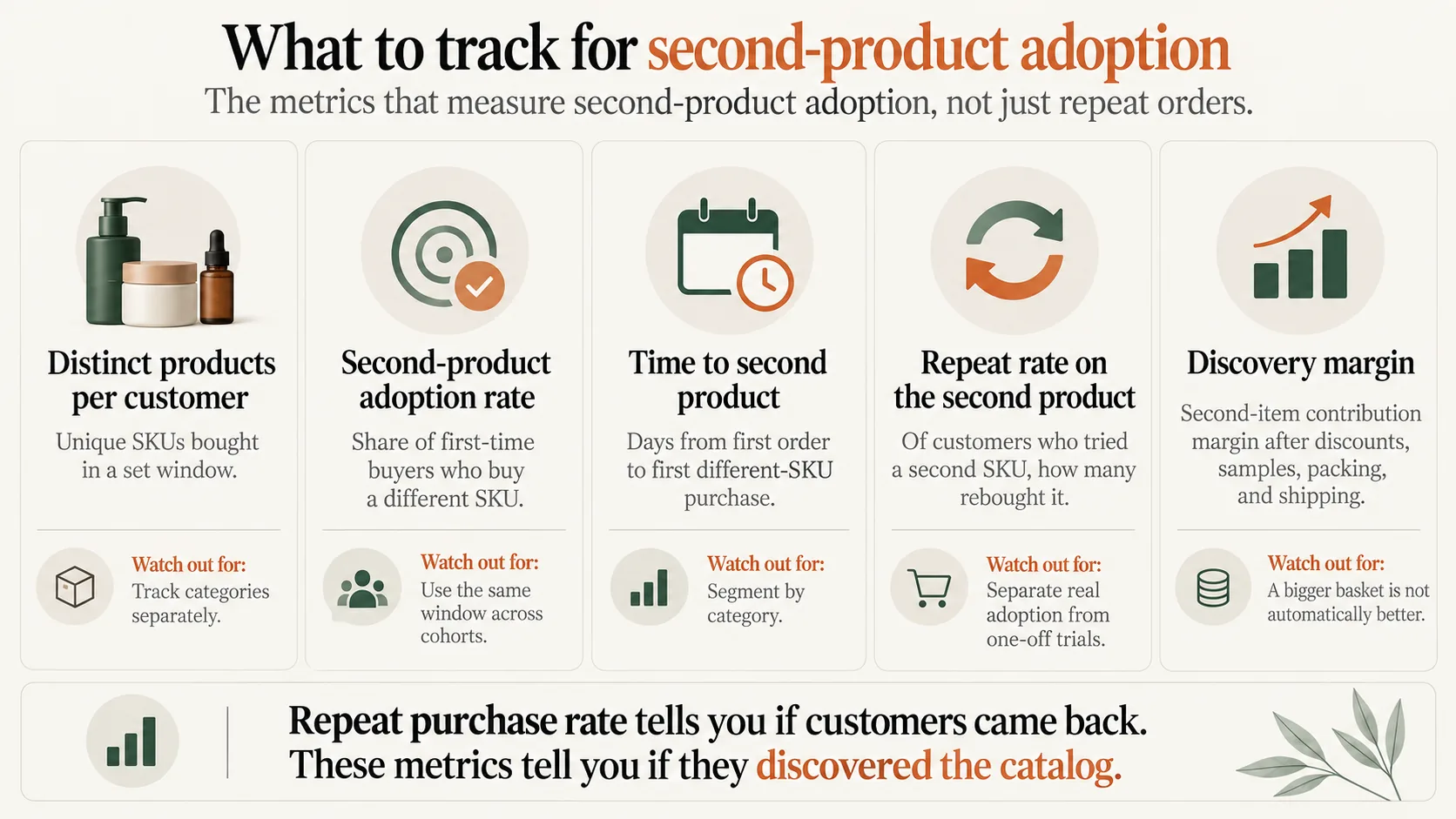
Repeat purchase rate tells you whether a customer came back, not whether they discovered the catalog. For that second question, track product breadth alongside retention, not instead of it.
- Distinct products per customer. Unique SKUs bought in a set window, such as 90 days. Track distinct categories separately; two flavors of one product are not broad adoption.
- Second-product adoption rate. The share of first-time buyers who buy a different SKU in the window. This is your cross-sell rate. Use the same window and exclusions across cohorts.
- Time to second product. Days from the first order to the first different-SKU purchase. Segment by category so slow-replenishment products do not skew it.
- Repeat rate on the second product. Of those who tried a second SKU, how many rebought it. This separates a real trial from a one-off promotion.
- Economics of discovery. Second-item contribution margin after discounts, samples, packing, and shipping. A bigger basket is not automatically better; a cross-sell that lifts customer lifetime value beats one that lifts a single order.
To learn whether an intervention works, hold out a control. Keep a random portion of eligible single-product repeat buyers out while another group gets a SKU-specific insert, an add-on prompt, or a timed recommendation, then compare second-product adoption and later retention over the same period. A higher purchase rate among people who voluntarily clicked an offer is not proof the offer caused it, because those customers were probably more interested to begin with.
Pro tip. Put every cross-sell SKU through the “repeat rate on the second product” test before you call it a winner. An offer that gets tried once and never rebought has lifted this month’s AOV and done nothing for retention, which is the opposite of what cross-sell is for.
How to increase your cross-sell rate
The steps above reduce to five decisions. To raise second-product adoption and move the cross-sell rate, work them in order:
- Pick the right companion, not the richest one. Map each hero SKU to the product that solves the customer’s next real problem. Complementary product recommendations beat high-margin add-ons.
- Wait for the usage window. Time the offer to when the customer has used the first product enough to want the next, not the morning after delivery.
- Use the surfaces the customer is already on. A subscription add-on or a matched package insert reaches an engaged customer more cheaply than another broadcast email.
- Exclude what they already have. Use purchase history to suppress owned products and anything declined twice, so every recommendation stays relevant.
- Measure adoption and repurchase, then hold out a control. A cross-sell only worked if the second product gets bought again, and only the holdout proves the offer caused it.
What this needs is knowing, per customer, which product fits next and when they are ready, across the whole list at once.
Match the second product to the moment
Cadence reads each customer’s purchase behavior and product relationships to identify a complementary product they are likely to try next, then estimates when the recommendation is useful instead of firing on a morning-after timer. The recommendation can appear through email, SMS, or on-site and send the customer into a pre-filled Shopify cart.
The aim is not more offers. It is a relevant second product, timed to when the first product has created enough context for the recommendation to make sense.
Book a 20-minute demo or install Cadence on Shopify.
FAQ
What is a good cross-sell rate for a consumer packaged goods (CPG) brand?
There is no universal number, because it depends on your catalog and how naturally your products pair. A skincare line with an obvious routine should see higher second-product adoption than a brand built around one hero SKU. The useful benchmark is your own second-product adoption rate on a rolling 90-day cohort, measured with consistent exclusions, so you can watch it move rather than compare against a figure from a different category.
How do you cross-sell to existing customers without being pushy?
Lead with a product that solves their next problem, and time it to when they have used the first one long enough to care. A single relevant recommendation tied to a real use case reads as help; a constant stream of “you may also like” reads as noise. Suppress anything they already own or have declined, and the offers you do send stay welcome.
When should you cross-sell after a purchase?
After the customer has used the first product enough to understand why a second would help, not the next morning. The exact window depends on the product’s usage cycle, so segment by category rather than sending everyone the same day-1 or day-7 email. Purchase date is only a rough proxy for use, so where you do not know actual usage, do not pretend the timing is precise.
How do you choose which products to cross-sell?
Start from the use case, not the margin. Map each hero SKU to the product that comes next in the same routine, cleanser to moisturizer, Sizzle to Drizzle. A claim like “people who buy this also buy that” should only appear when your own order data shows that product affinity. A simple hero-SKU-to-next-SKU map is enough to begin, so you do not need a recommendation engine for the first test.
How do you measure second-product adoption?
Among first-time buyers who have had a full observation window, measure the share who buy a different SKU inside it, using the same window and exclusions across cohorts. Then check the repeat rate on that second product, because a trial that never gets rebought is a promotion, not adoption. To prove an intervention caused the lift, hold out a random control group rather than crediting everyone who clicked.
Does cross-selling hurt replenishment or subscriptions?
No, when it is sequenced. Replenishment and subscription reorders are the foundation, and cross-sell is layered onto the shipments and moments the customer is already engaged. Offer the add-on before the order-edit cutoff, never add a paid item automatically, and suppress out-of-stock offers. Done this way, discovery makes the next delivery more useful instead of competing with it.
What to do next
Pick your three highest-volume hero SKUs, map one genuinely useful companion product to each, and set the offer to land partway through the first product’s usage window instead of the morning after. Then measure second-product adoption and the repeat rate on that second SKU against a held-out control. That one test tells you more about your catalog than any benchmark, and it is the smallest version of the whole system.
For consumer packaged goods (CPG) brands, the goal is not to force a larger basket. It is to help customers discover the next product that genuinely fits. See which second product each of your customers is most likely to try next. Book a 20-minute demo or install Cadence on Shopify.