That sounds too low, until you pull your own 90-day cohort and count. A first order is easy to explain: a discount caught someone’s eye, a creator mentioned you, the packaging stood out, curiosity did the rest. None of that means the customer chose you. It means they tried you once.
The second order is the one that counts. By then the customer has used the product, felt the packaging, dealt with your delivery, and formed a real opinion on price. A reorder is the first hard evidence that the product held them. Your repeat purchase rate is just that counted across every customer, and it is the number that tells you whether the brand is holding people or quietly leaking them. Almost everything that moves it takes place in the gap between the two orders, where most brands do nothing but wait.
AI insight extraction
Reading article context…
Key takeaways
- Most first-time CPG customers never come back. On a typical Shopify catalog only about 27% place a second order, so most acquisition spend buys a single purchase.
- A repeat order is a choice, not a trial. By the second purchase the customer has judged the product, the price, and the delivery, so a reorder is the first real signal that the brand held them.
- If every reorder needs a discount, the product is not doing the retaining. A coupon can start a habit. It should not be the only reason one exists.
- Retention is built between the two orders, not in one email. Whether the product got used, whether the reminder landed on time, and whether reordering was easy all decide the outcome.
- A repeat order does not have to be the same SKU. A face-wash buyer moving to the moisturizer is still repeat revenue, which makes product discovery part of retention.
- Timing beats frequency. Reaching a customer the day they actually run out converts better than a fixed day-30 blast sent to everyone.
A first order shows interest. A repeat order shows value.
Customers place a first order for reasons that have little to do with the product. A discount, a recommendation, the packaging, curiosity. By the second order those reasons are gone. The customer has used the thing, weighed the price against the experience, and decided to spend again anyway.
That is why the repeat order is the clearest retention signal you have. It is actual retention, measured after use, not projected retention modeled from a first purchase.
What happens between the two orders
The journey most brands picture is ad → purchase → done. The real one runs longer: first order, product experience, value, engagement, repeat order. What happens in that middle stretch decides everything, and it is exactly the part no campaign is watching.
Five questions worth asking about every customer who has ordered once:
- Did the product deliver what the ad and the page promised?
- Did the customer understand how to use it?
- Did it become part of a routine, or sit unused?
- Do they know what to try next?
- When they are ready to buy again, is it actually easy?
A single well-timed email does not create retention. It is built or lost across this whole stretch, and a customer can fall out at any point in it.
Don’t let the discount be the reason they come back
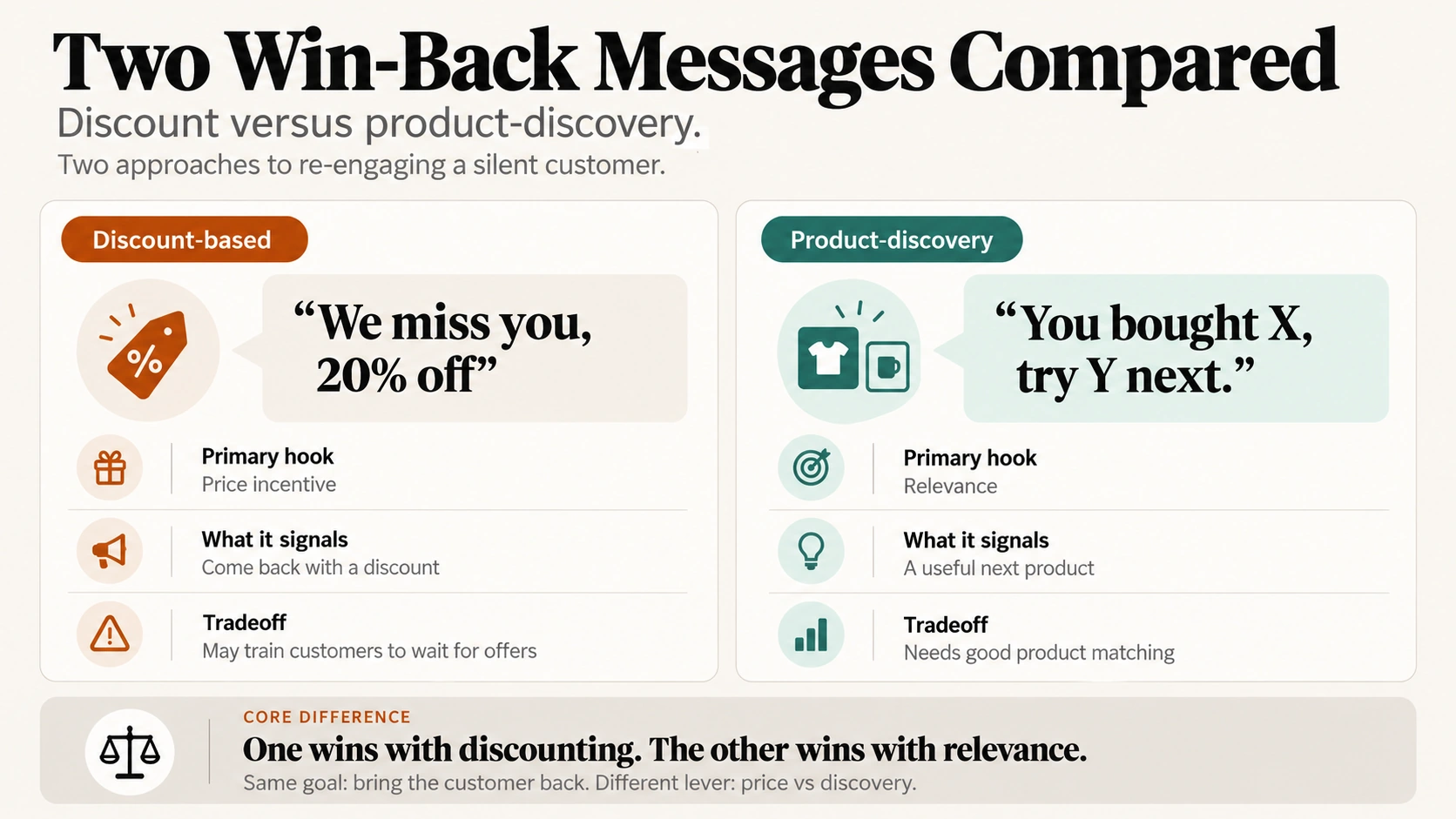
A discount is a fair way to get someone to try a product once. The problem starts when every repeat order needs another one.
At that point the honest question is not whether customers are returning. It is whether they are returning for the product or for the coupon stapled to it. If the coupon is the only reason left, you are not retaining customers. You are renting them, and the rent goes up.
This is not an argument against promotions. It is an argument against the promotion being the last reason standing. A customer reorders because the product worked, because it fits a routine they already have, because they found something else in your catalog worth trying, or simply because reordering was easy. The stronger those reasons are, the less you have to discount to close the next sale.
The second purchase may come from another SKU
A customer can stay with the brand without buying the same item again. Someone who bought face wash may need moisturizer before they need another cleanser. A protein-bar buyer may switch flavors. A single-pack buyer may move to a bundle. If you only look for a repeat of the first SKU, you can miss real repeat behavior.
Use the first order as context for the next recommendation. Instead of sending the whole catalog or defaulting to a discount, narrow the choice to products that logically follow from what the customer already bought.
“20% off if you come back today.”
“Bought the face wash? Here’s the moisturizer that fits the same routine.”
The first message buys attention with margin. The second reduces the choice set and gives the customer a specific next product to consider. The recommendation still has to make sense, but relevant product discovery can create the second order before the original product needs replenishment.
Make the repeat order easy to place
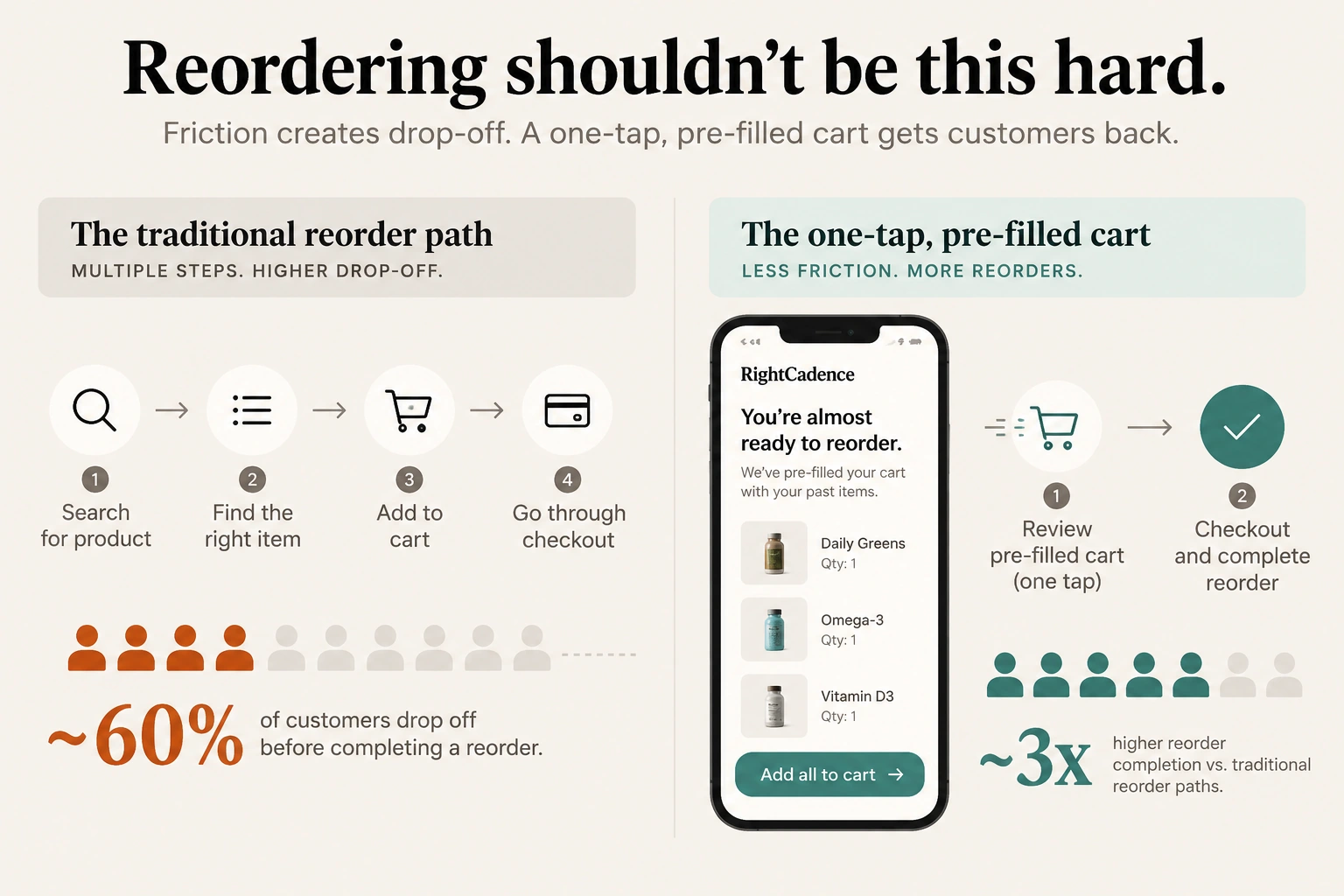
Sometimes a customer does not return because they stopped liking the product. They hit reorder friction: finding the site again, searching for the item, remembering which variant they bought, entering everything at checkout from scratch. Each extra step is another chance to drop off before the reorder happens.
Removing that friction for a consumer packaged goods (CPG) brand is direct:
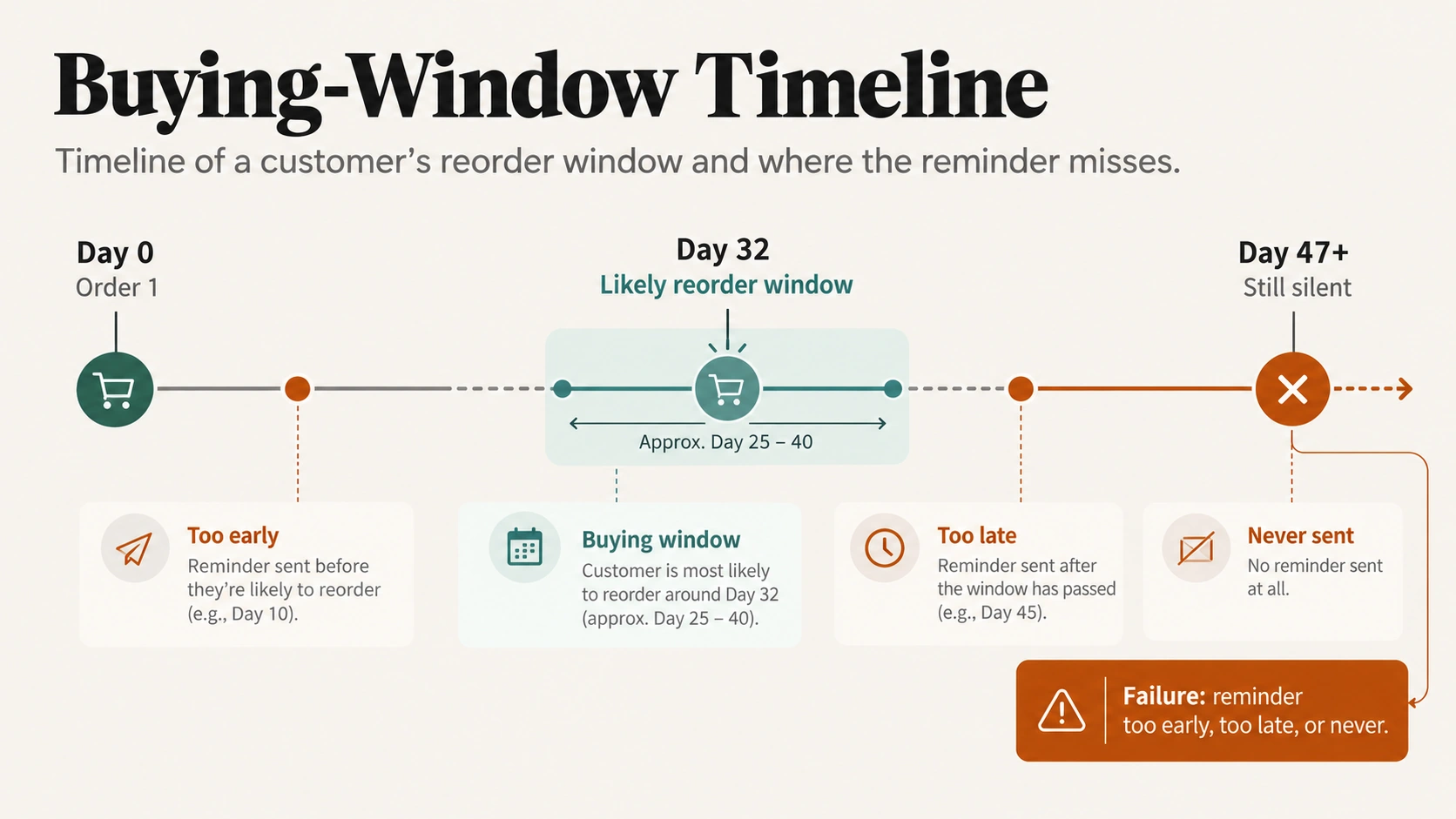
- Send a reminder timed to when the product is likely to run out, not on a generic day-30 timer.
- Make past purchases easy to find and reorder in one click.
- Recommend the next relevant product instead of the same one by default.
- Save preferences so the customer is not re-entering the same choices.
- Cut the reorder flow to as few steps as checkout allows, ideally a pre-filled cart.
Once a customer already knows what they want, the only job left is to make getting it fast.
Measure what happens after acquisition
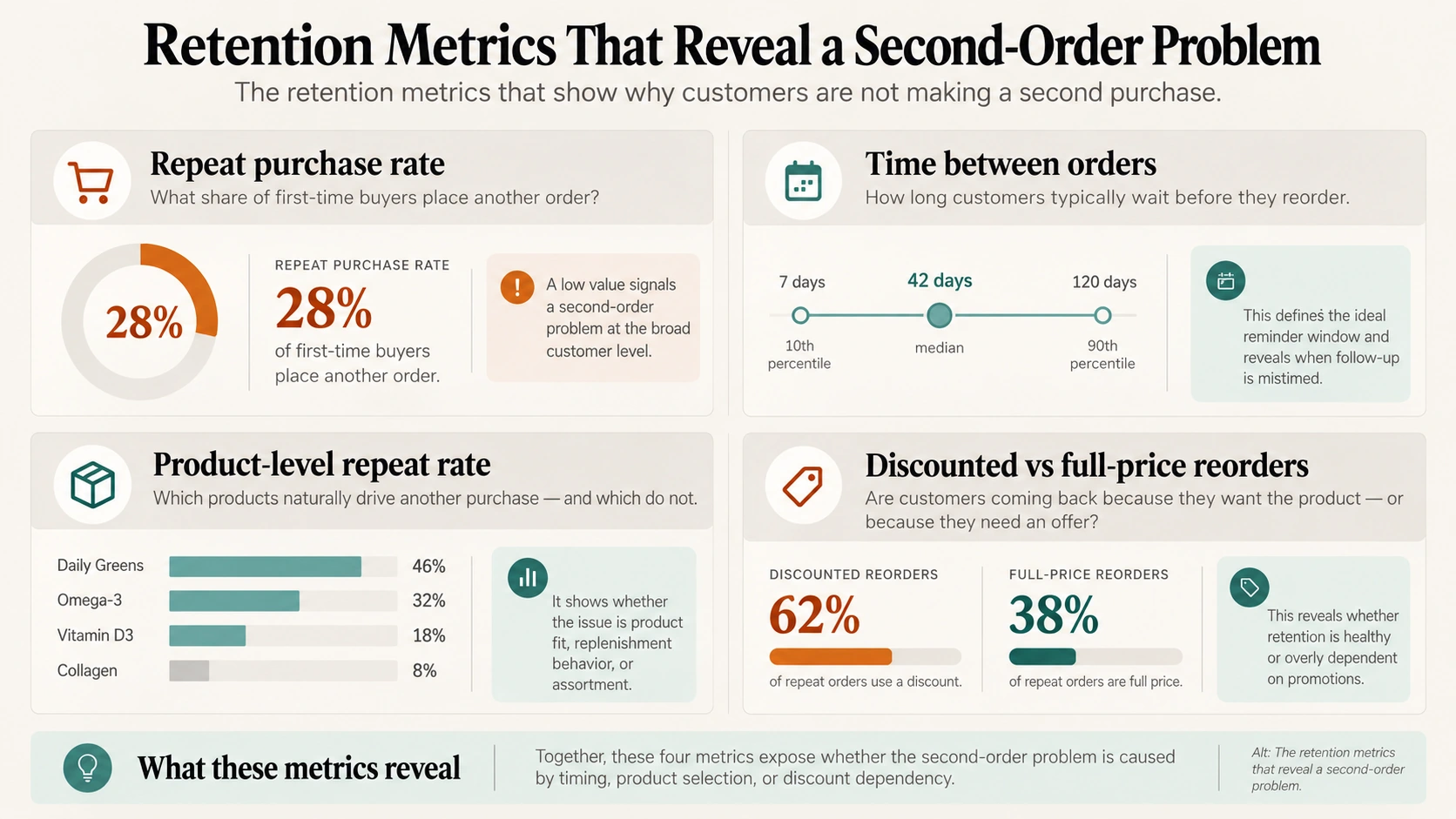
Acquisition metrics tell you how many customers arrived. They say nothing about what happened next. Retention metrics fill that gap, and these are the ones worth watching:
- Repeat purchase rate
- Second-order rate, sometimes called the second purchase rate
- Purchase frequency
- Time between orders, or time to second purchase
- Product-level repeat rate
- Discounted versus full-price repeat orders
- Customer lifetime value
- Cohort retention
Repeat purchase rate = customers with two or more orders ÷ total customers over a set period.
Repeat purchase rate is the plainest of these: customers with two or more orders divided by total customers over a set window. Across CPG and DTC brands on Shopify the second purchase rate commonly sits near 27%, so that is a fair baseline to measure your own against.
These point to where the problem actually sits. A product with plenty of first-time buyers and few repeat customers rarely has an acquisition problem. The cause is more likely the product experience, the price, replenishment timing, a lack of product discovery, or friction in the reorder path. A repeat order confirms something worked. These numbers tell you what.
How to increase your repeat purchase rate
Everything above comes down to five levers. To increase repeat purchases and move the rate, work them in this order:
- Time the ask to the customer, not the calendar. Reach each customer near the day they actually run out, not on a fixed day-30 blast.
- Make the reorder effortless. Cut reorder friction to a pre-filled cart so intent does not leak between “I want this again” and checkout.
- Give them somewhere to go next. Use cross-sell to point a face-wash buyer at the moisturizer instead of showing everyone the same bestseller.
- Catch lapses before they harden. Watch each customer’s reorder window and act when they drift past it, rather than waiting for a win-back.
- Stop leaning on the coupon. Keep discounts for starting a habit, not sustaining one, so margin is not paying for every repeat order.
None of the five is exotic. What makes them hard at scale is knowing which customer is at which stage today, across your whole list.
Turn these signals into better timing
Cadence uses each customer’s purchase history to estimate when replenishment is due, when a lapse is starting, which product is a likely next purchase, and when a repeat buyer may be ready for a subscription. Those signals can trigger email, SMS, or on-site messages when they are relevant, with a pre-filled Shopify cart ready for checkout.
The product still has to earn the repeat order. Cadence handles the timing and removes unnecessary steps between intent and purchase.
Book a 20-minute demo or install Cadence on Shopify.
FAQ
What is a good repeat purchase rate for a consumer packaged goods (CPG) brand?
There is no single benchmark, because it depends on your category and how fast the product is consumed. A consumable with a 30-day cycle should see a far higher repeat rate than a durable one bought twice a year. The most useful benchmark is your own second-order rate over a rolling 90 days: if it sits near the common ~27%, moving it up even a few points compounds across every future cohort.
Why don’t customers reorder, even when they liked the product?
Most lapses are not about dissatisfaction. Customers run out and forget, or the reminder arrived too early or too late, or reordering meant finding the site and rebuilding the cart from scratch. The intent to buy again was there; the timing and the friction lost it.
Do subscriptions fix retention?
Subscriptions help, but subscription conversion only works when the ask lands at the right time. Pushing every first-time buyer to subscribe is premature and gets ignored, while waiting too long leaves recurring revenue on the table. The signal to watch is an established repeat pattern: a customer who has already reordered on their own is the one ready to commit.
Should I use discounts to drive repeat orders?
Use them to start a habit, not to sustain one. If a customer only reorders when a coupon is attached, the discount is doing the retaining and your margin pays for it every cycle. Lead with timing, product fit, and an easy reorder, and keep the discount as an occasional tool rather than the standing reason to return.
How is a win-back different from a replenishment reminder?
A replenishment reminder reaches a customer before they lapse, timed to when they are about to run out. A win-back fires after they have already gone quiet past their normal window. Replenishment prevents customer churn; win-back tries to reverse it on already-lapsed customers, which is harder and often needs a stronger offer. Catching the customer earlier is cheaper than recovering them later.
How do you calculate repeat purchase rate?
Divide the number of customers who placed two or more orders by your total number of customers over a set period, then read it as a percentage. A brand with 1,000 customers and 270 who ordered again has a 27% repeat purchase rate. Measure it on a rolling 90-day cohort so recent customers who have not yet hit their reorder window do not drag the number down.
How do you turn first-time buyers into repeat customers?
Get the second order by removing the three things that usually block it: bad timing, friction, and no next step. Reach the customer near the day they run out, make reordering a one-tap pre-filled cart, and point them at the right next product instead of the same one. Leading with a discount can start the habit, but it should not be the only reason they come back.
The next order, not just this one
Consumer packaged goods (CPG) brands that hold onto customers do not treat each purchase as a closed transaction. They plan for what comes next: a reason to use the product after the first order, a reason to return after using it, and an easy path back when the customer is ready. The first order starts the relationship. The repeat order is what keeps it running, and it keeps running because the product earns it, not because another coupon is waiting at the end.
See what lifecycle timing could earn from the customers you already have. Book a 20-minute demo or install Cadence on Shopify.