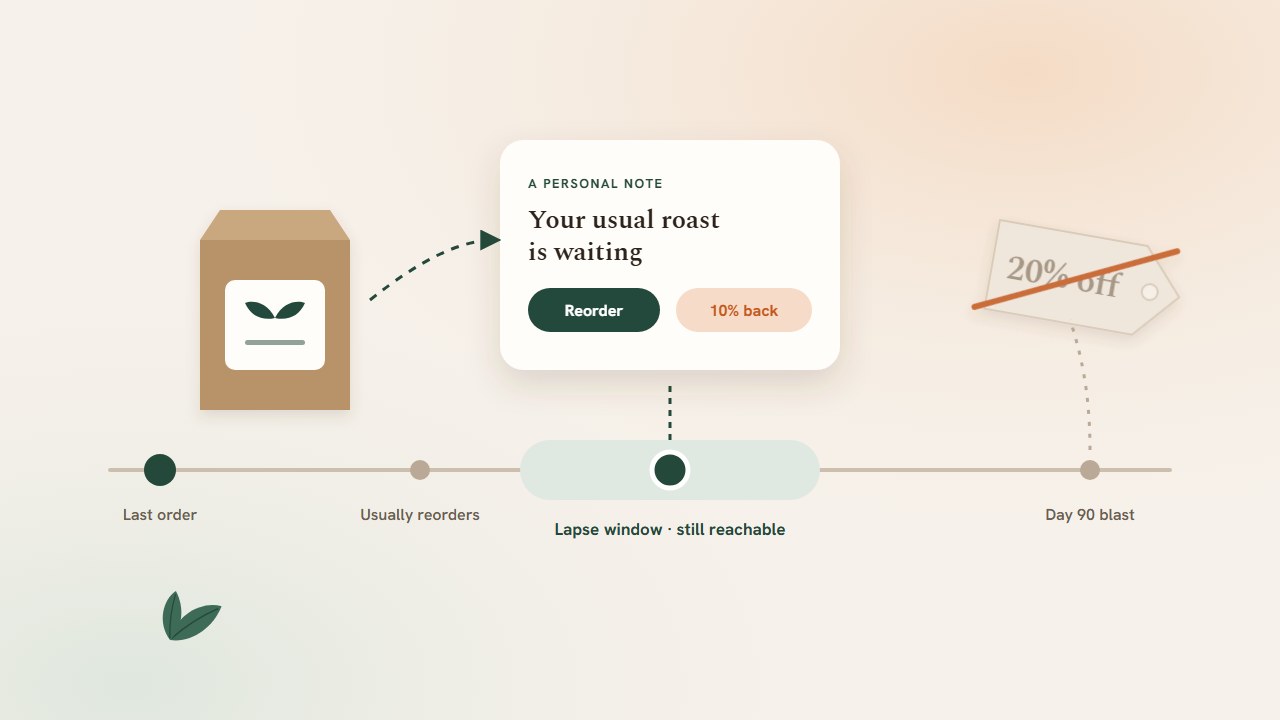
When a customer stops buying, the reflex is to send a bigger discount. 15% off. Then 20%. Then free shipping on top. It works, once. Then the customer learns that silence gets rewarded.
For a consumables brand, that lesson is expensive. Customers who learn to wait for a win-back offer start waiting on purpose. Your average discount depth creeps up, your margin on repeat orders falls, and the “recovered” revenue in your reports includes orders that would have arrived anyway at full price.
There is a better lever than discount depth, and it is timing. This guide explains why win-back campaigns usually fire too late, what a lapsing customer actually needs from you, and how to recover them while protecting margin.
AI insight extraction
Reading article context…
Key takeaways
- Win-back usually fails on timing, not on the size of the offer. A generic 90-day “we miss you” email reaches many customers after they have already switched brands.
- “Lapsing” depends on the customer. A customer who reorders every 25 days is lapsing at day 40. One who reorders every 60 days isn’t. A store-wide threshold misreads both.
- Personal context beats a bigger percentage. “Your usual roast is running low” does more work than “20% off everything,” and it costs nothing.
- Make the offer small, product-specific, and limited to lapse. A modest discount reserved for customers who are actually drifting protects margin on everyone else.
- Remove friction so intent turns into an order. A lapsing customer who clicks should land on a pre-filled cart, not a homepage.
- Measure recovered customers honestly. Count purchases that came directly from the win-back path, and compare against a holdout where you can.
The discount trap
Discount-led win-back works on the first send and degrades every time after. The mechanics are easy to see:
- A customer goes quiet.
- They receive “20% off, we miss you.”
- Some of them buy, and the campaign looks like a success.
- Next cycle, more customers go quiet, because some of them have learned that quiet means 20% off.
- The offer has to escalate to keep producing the same lift.
The campaign report shows recovered revenue. What it does not show is the full-price orders you converted into discounted ones, or the customers you taught to reorder only on promotion.
There is a second cost. A blanket “20% off everything” message tells the customer nothing about why they should come back. It treats a loyal two-year customer the same as someone who bought once during a sale. The offer is generic, so it lands as marketing, not as service.
Timing beats discounting
The most effective win-back is the one that arrives while the customer still remembers why they bought. At that point a light reminder is often enough. Wait too long and they’ve formed a new habit with another brand, and no discount you can afford will win them back.
Most brands use a single store-wide threshold, such as “no order in 90 days,” because it’s easy to set up. Here’s why it misfires:
| Customer | Usual reorder rhythm | Day 45 with no order means | What a 90-day win-back does |
|---|---|---|---|
| Fast replenisher | Every 25 days | Seriously overdue, probably buying elsewhere | Arrives about two missed cycles too late |
| Typical | Every 35 days | Starting to drift | Arrives after the habit has likely broken |
| Slow replenisher | Every 60 days | Not due yet | Arrives about on time |
The same threshold is far too late for some customers and about right for others. Lapse is a per-customer judgment, measured against that customer’s own buying rhythm for the product.
Recognizing the lapse window
A customer becomes a win-back candidate when they have passed the point they would normally have reordered and haven’t come back. That period, after they are overdue but before they are gone, is the window worth targeting. Some customers are just a few days late because a vacation or a bigger pack delayed their need. Others have quietly switched.
You can’t tell those two groups apart for certain, which is another reason to keep the first message light, personal, and low on discount. The customer who was simply busy will buy at full price. The one who has drifted needs a stronger reason, and you can save the incentive for them.
What works better than deeper discounts
Personalized product context
“Your Vitamin C Serum is waiting” beats “20% off everything.” Naming the product the customer actually bought reminds them of a routine they already had, and makes the message feel like a reminder, not a sales pitch. It also lands better with customers who were simply busy than with those who were truly lost, which is exactly who you want to convert at full price.
Right-sized offers
If you use an incentive, make it:
- Modest. A small welcome-back offer on the product they already know is often enough.
- Product-specific. Tie it to the item they used to buy, not a sitewide sale.
- Reserved for lapse. Don’t offer the same discount on routine replenishment, or regular buyers will learn to wait.
One-tap purchase
A lapsing customer has the lowest patience of anyone on your list. If the click lands on a homepage and asks them to find the product, choose a variant, and log in, you’ve added friction at the exact moment their intent is weakest. The click should open a cart that already holds their product, with any offer applied automatically.
A useful reason to come back
Sometimes a customer lapses because the product stopped fitting: the scent got old, the flavor got boring, or their needs changed. A lapse message that points to a relevant alternative or a new variant can bring back a customer that no discount on the old product would.
The margin-preserving playbook
- Find customers entering the lapse window, measured against their own reorder rhythm, not a single store-wide threshold.
- Send a personal message about the product they actually bought, while the habit is still recent.
- Use a modest, product-specific offer only for customers who are lapsing. Keep it off routine replenishment.
- Link to a pre-filled cart so the customer can buy with one tap and no login, with any discount already applied.
- Follow up with SMS or an on-site message for customers who visit the store but haven’t reordered.
- Measure recovered customers by purchases made directly through the win-back path, and compare against a holdout where possible.
Common mistakes
Escalating the discount on every send. If the second email offers more than the first, customers learn to ignore the first.
Running lapse and replenishment offers at the same depth. Then the customer has no reason to pay full price on time.
Ignoring the “too early” case. A customer with a 60-day rhythm who gets a win-back message on day 40 feels pestered, not missed.
Counting every order as recovered. If you credit win-back for every purchase within 30 days of a send, the campaign gets credit for customers who would have returned anyway.
Sending the same message to a one-time sale buyer and a long-term customer. Their reasons for leaving, and what will bring them back, are different.
How to measure win-back without fooling yourself
| Metric | Why it matters |
|---|---|
| Customers entering lapse | The size of the problem each period |
| Recovered customers | Lapsing customers who purchase directly through the win-back path |
| Recovered revenue | Revenue from those purchases |
| Average discount on recovered orders | Whether you are buying the recovery with margin |
| Repeat after recovery | Whether the customer ordered again afterward, or only took the one deal |
The last metric matters most. A recovered customer who reorders at full price on their next cycle is a real win. One who only came back for the deal is a single discounted order.
How Cadence handles lapse prevention
Cadence treats lapse as one of four prediction types, along with replenishment, cross-sell, and subscription upsell.
Detection. Cadence learns each customer’s buying rhythm from their Shopify order history, per product, and recalculates predictions daily. When a customer hasn’t reordered within their expected window, Cadence flags them as about to lapse. A replenishment prediction that goes unanswered can escalate into lapse prevention. Thresholds are managed by Cadence and tuned to each store’s data. You don’t have to choose a store-wide number of days.
Delivery. Cadence sends a cadence_prediction event with prediction_type set to about_to_lapse to your marketing platform: Klaviyo, Omnisend, Attentive, or Postscript. Your win-back flow sends the email or SMS using your own creative and the product details from the event.
The offer. In ConvertCart settings you can set an optional Shopify discount code for each prediction type. That means you can attach a modest win-back offer to lapse prevention only and leave replenishment at full price. The code is applied automatically when the customer checks out through ConvertCart.
The cart. Every event includes a cart_url that opens ConvertCart, a branded, login-free cart pre-filled with the customer’s product, which checks out through standard Shopify checkout. Lapsing customers who browse your store while logged in can also see an on-site Nudge with the same cart.
Measurement. Revenue is attributed only when a customer clicks a ConvertCart link and completes checkout. Prediction analytics break revenue down by prediction type, so you can see lapse prevention on its own.
Hearth & Harvest, a specialty food brand, used this approach to catch lapsing customers around day 45 instead of day 90. With an average 10% win-back offer, down from 20%+ on their old campaigns, they recovered $142K. Read the case study.
Frequently asked questions
When should a win-back email be sent?
Once a customer is past their own usual reorder point and hasn’t come back, while the habit is still fresh. That point is different for every customer and product, which is why a single “90 days since last order” rule tends to be late for fast replenishers.
How much discount should a win-back offer include?
As little as works. Start with a personalized reminder and a small, product-specific offer, then test whether a larger one actually recovers more customers or just discounts customers who would have come back anyway.
Should I stop discounting replenishment?
For most CPG brands, yes, or at least keep replenishment offers smaller than lapse offers. A customer who is due to restock already plans to buy, so a discount there mostly gives away margin.
How do I know win-back is working?
Track recovered customers and their next order, not just the first recovered purchase. Where possible, hold out a random group of lapsing customers who don’t get the campaign and compare their return rate.
What to do next
Pull your last win-back campaign and check two numbers: the average days since last order when it fired, and the average discount on the orders it recovered. If the first is “90” and the second is “20%,” you are reaching customers late and paying heavily to bring them back.
Cadence catches lapse per customer, while it is still recoverable, and lets you keep the offer small. Book a 20-minute demo or install Cadence on Shopify.